

Bitcoin Has Held Its 50-Week Average for Weeks. Galaxy's Alex Thorn Says the Bottom Is In
Galaxy's Alex Thorn on why he thinks bitcoin bottomed in June, who is selling and buying, and how AI spending feeds the debasement trade.
In every past bear market, Galaxy's Alex Thorn says, bitcoin holding above its 50-week moving average for several weeks meant the low was already in. He tells Laura Shin the signal has now held for five or six weeks and dates this cycle's bottom to late June, walking through his essay "Why Now Is the Time to Add and Hold BTC."
13F filings show Millennium and D.E. Shaw trimming their bitcoin ETF holdings while sovereign wealth fund Mubadala and Morgan Stanley Wealth Management added.
Long-dormant coins are moving at about 34,000 BTC a month in 2026, roughly half the 67,000 a month seen in 2024.
He argues a $40 trillion U.S. national debt and a credit-funded AI buildout make the debasement case stronger than it was at bitcoin's record high.
He names what would break the thesis, including a sustained drop below the 50-week average and a quantum computer.
The episode posted Thursday, the same day the Binance hack sent bitcoin lower. On Friday it touched a six-week low near $76,000.
Watch on YouTube · Listen on Apple Podcasts · Spotify
Make your voting plan
Election Day is Nov. 3. Whether you vote early or in person, the Stand With Crypto Voter Hub helps you check your registration, find your state's deadlines and look up your ballot. It also shows how your candidates are graded on crypto.

Tell Us What to Make Next, and Get a Free Month of Premium
Our listener survey is open through Sunday, Nov. 8. It's anonymous, and your answers help decide whether we add a weekly recap show, when we stream and what goes into Premium.
Everyone who finishes gets a free month of Unchained or Bits + Bips Premium, your choice. I read every write-in answer myself.
~Laura
In this week's edition:
🚨 Binance loses $6.3 billion in crypto's largest hack
🏛️ ICE and Druckenmiller back Hyperliquid perps for US traders
📉 Bitcoin shrugs off the Fed, but not the Binance hack
🐙 Kraken's parent lines up for Hyperliquid's new allowlist
🔐 Keystone scraps 18,835 wallets; Passport traces phishing to a breach
📇 Coinbase blames vendor Amplitude for a contact-data leak
🔎 Polymarket faces a CFTC probe and another security incident
⚖️ Utah charges Kalshi with felonies as it hits $40 billion
💸 Strategy reports Q3 earnings as it switches to daily dividends
🇧🇷 Lula wins at 20% odds, and traders argue over the markets
🏦 Ripple gets a trust bank charter and a Moody's A2
🕵️ Trezor flags a possible implant in one of its wallets
😂 Fun Bits: out of the cold wallet, into the hot one
Binance Loses $6.3 Billion in Crypto's Largest Hack on Record
Attackers drained about $6.3 billion from Binance's hot wallets on Thursday, more than four times the $1.5 billion taken from Bybit in February 2025 and the biggest theft in dollar amount in crypto history. Most of it left across 10 networks in a 20-minute burst starting at 20:05 UTC, by TRM Labs' count. TRM attributed the attack with high confidence to TraderTraitor, the North Korean group the FBI blamed for Bybit.
Binance first pointed to a compromised DevOps engineer's laptop, then said in a Friday update that it had "uncovered additional points of breach." About $3 billion is frozen onchain, much of it stablecoins Tether and Circle locked within about an hour. Binance has pledged to cover every loss and set aside $6.34 billion, $5 billion of it in the stolen tokens themselves.
Withdrawals remain suspended. Binance aims to start restoring them in phases "within approximately 34 hours" of its Friday update, which points to early Sunday UTC (co-CEO Yi He earlier said 48 hours), with proof-of-reserves results due Monday. ZachXBT said the same actor is likely behind September's $388 million Bitget hack.
NYSE Owner ICE and Stan Druckenmiller Back Hyperliquid Perps for US Traders
Intercontinental Exchange, parent of the New York Stock Exchange, is taking a minority stake in trade.xyz and plans to run a separate U.S. exchange and clearinghouse for its 24/7 perpetual futures on Hyperliquid, covering stocks, indexes, commodities, FX and crypto. Perps are futures contracts with no expiry date.
Billionaire Stan Druckenmiller confirmed he is investing too and plans to use the product "to enhance my investment process." Elon Musk quote-posted him with one word: "Interesting."
Nothing is live. ICE says the plan is "subject to regulatory approvals" from the CFTC. In May, ICE CEO Jeffrey Sprecher called Hyperliquid "bigger than NASDAQ," about two weeks after Bloomberg reported ICE and CME had urged regulators to look into it over manipulation risks.
Bitcoin Shrugs Off a Hawkish Fed, but Not the Binance Hack
The Federal Reserve held rates at 3.75% to 4% on Wednesday in a 10-2 vote, with Governor Lisa Cook and the Cleveland Fed's Beth Hammack pushing for another hike. Bitcoin barely reacted. It gained 0.33% on Coinbase through the afternoon, and Deribit's DVOL index of 30-day implied volatility finished near where it started, around 37.6, even as traders raised the odds of a December hike to 82.6% from 78.3%.
The calm lasted a day. After the Binance hack, bitcoin fell to about $76,100 on Friday, its lowest since mid-September. More than $1.5 billion in leveraged positions were liquidated, most of them longs.
Kraken's Parent Wants to Be First to Use Hyperliquid's New Access Controls
Hyperliquid is testing an optional allowlist that lets whoever launches a market decide who can trade it, and Payward, the parent of Kraken, wants to be the first CFTC-regulated firm to use it. The feature builds on HIP-3, the system that lets outside teams launch their own perpetual futures markets on Hyperliquid.
Payward would keep everything in-house. Its Bitnomial unit, a CFTC-registered exchange and clearinghouse, would list and clear the contracts, and its NinjaTrader Clearing unit would hold client accounts. The feature is on testnet only, with no launch date, and still needs regulatory approval. Hyperliquid itself remains closed to U.S. users.
Keystone Scraps 18,835 Wallets as Two Hardware Wallet Makers Disclose Breaches
Keystone said an intruder took customer names and addresses from its online store, then disclosed that the attacker also got the key behind its device-authenticity checks. Because that key is burned into each wallet at the factory, a copy could be used to build counterfeits that pass Keystone's own check. The company will destroy 18,835 wallets in stock and is switching to a new key. It also admitted that some of the 25,964 exposed buyer records had been kept past its own 180-day deletion limit.
Foundation, maker of the Passport bitcoin wallet, traced phishing emails sent from its own domains to a backend breach that likely reached its support inbox. Some carried buyers' real names and addresses and steered them toward typing their seed phrase into a fake site. Both companies say recovery phrases weren't exposed.
Coinbase Says a Vendor's Breach Exposed Some Customers' Contact Data
Coinbase said contact details and limited transaction data for "a small subset" of customers were exposed in an incident at Amplitude, an analytics provider, and that its own systems were not breached.
A spokesperson told Unchained no home addresses or account-access details were involved and that funds were untouched.
Coinbase hasn't said how many users were affected. It called a viral claim of more than 70,000 "false" and said it believed the number started with Grok, X's AI chatbot, confusing the incident with Coinbase's May 2025 insider breach.
Two days later, Coinbase reported third-quarter net income of $719 million, driven largely by gains on crypto it holds, and said prediction markets now bring in more than $200 million a year.
Polymarket Faces a Renewed CFTC Probe and Another Security Incident
The CFTC is investigating whether Polymarket kept U.S. users off its offshore market as a 2022 settlement required, Reuters reported Tuesday, including how it checked users' locations and marketed in the U.S. Federal probes into the same question closed in July 2025 without charges.
On Thursday, Polymarket paused trading for about an hour after a third-party provider was compromised, its third security incident since May, and pledged to repay affected traders. Outside estimates of the loss run from about $2.2 million to $2.65 million.
Bloomberg also reported that Polymarket is reviewing dozens of new wallets that backed Benjamin Netanyahu and Likud shortly before polls closed in Israel's Oct. 27 election, though it said the findings weren't conclusive.
Utah Charges Kalshi With Felonies, and Kalshi Raises at a $40 Billion Valuation
Utah criminally charged Kalshi, CEO Tarek Mansour and COO Luana Lopes Lara with 12 felony counts of online gambling promotion among 14 charges. The case rests on 12 sports bets of $4 to $30 that a state agent placed in September, after federal courts declined to shield Kalshi from Utah's gambling ban. A Kalshi spokesperson reportedly called it "a crazy overreach." Days earlier, the CFTC had sued Utah to halt its civil case against Kalshi.
The next day, Kalshi announced a $1 billion raise at a $40 billion valuation, up from $22 billion in May, in a round co-led by Sequoia Capital and Wellington Management, CNBC reported. The money will fund single-stock perps and leveraged event contracts.
Strategy Sold Bitcoin in Q3 to Pay Dividends, Then Moves Them to a Daily Schedule
Strategy sold 5,552 bitcoin in the third quarter to fund preferred dividends and STRC buybacks, while buying 7,218, down from 85,296 in the second quarter. A $20.9 billion markup on its bitcoin produced record operating income. Without it, operations lost about $2.6 million. CFO Andrew Kang leaves Nov. 5.
Shareholders also approved daily dividends on Strategy's four perpetual preferred stocks, starting with STRC on Nov. 1. Executive Chairman Michael Saylor said 99.3% of votes cast were in favor.
Friday's sell-off took bitcoin close to what Strategy paid for it. The company holds 848,517 BTC at an average cost of about $75,446, per its earnings release, within about 1% of Friday's low.
Lula Wins Brazil's Runoff After Prediction Markets Gave Him 20% Odds
Polymarket and Kalshi had Flávio Bolsonaro as a roughly 80% favorite in Brazil’s presidential election on Sunday morning. By evening, Luiz Inácio Lula da Silva had won a fourth term with 51.8% of valid votes. Polymarket's market alone drew more than $249 million in volume.
Traders split on what it meant. Joe Weisenthal asked whether it was "one of the biggest prediction market whiffs of all time." Harry Crane replied: "First time a 4-1 shot has ever won in the history of betting?"
Runoff polls had given Bolsonaro only about 51%, a far narrower edge than the markets priced. Bolsonaro refused to concede and said he would seek to annul the result.
Ripple Wins a Federal Trust Bank Charter and a Moody's A2 for RLUSD
The OCC gave final approval to Ripple National Trust Bank, which will hold the reserves behind RLUSD, the $2.6 billion stablecoin. RLUSD will still be issued by Ripple's New York-regulated trust company, so the charter adds federal supervision on top of state oversight. Ripple hasn't said when the bank opens.
A day later, Moody’s assigned RLUSD an A2 deposit rating, which a Ripple executive called the first investment-grade Moody's rating for any stablecoin. Moody's flagged that holders don't directly own the reserve and said the GENIUS Act, the federal stablecoin law, will add protections once it takes effect in 2027.
Trezor Treats a Report of an Implanted Safe 5 as Credible
Trezor said Friday it is treating as credible a customer's report of a hardware implant in a Trezor Safe 5 bought from CryptoBilis, the reseller tied to this month's Ledger drains, though it hasn't examined the device yet. The described implant, an added board with a cellular module, would read the recovery phrase off the screen and send it out over a mobile network. Trezor asked anyone who bought from CryptoBilis since March to move funds to a new seed.
Implant reports are also coming from ordinary shops. Singapore police said some Ledger wallets sold in local stores contained malicious components, with about S$3.5 million (about $2.7 million) lost in at least two cases. Earlier, MediaMarkt Saturn pulled Ledger wallets from its shelves after a customer in Germany reported an implant.
Fun Bits: Out of the Cold Wallet, Into the Hot One
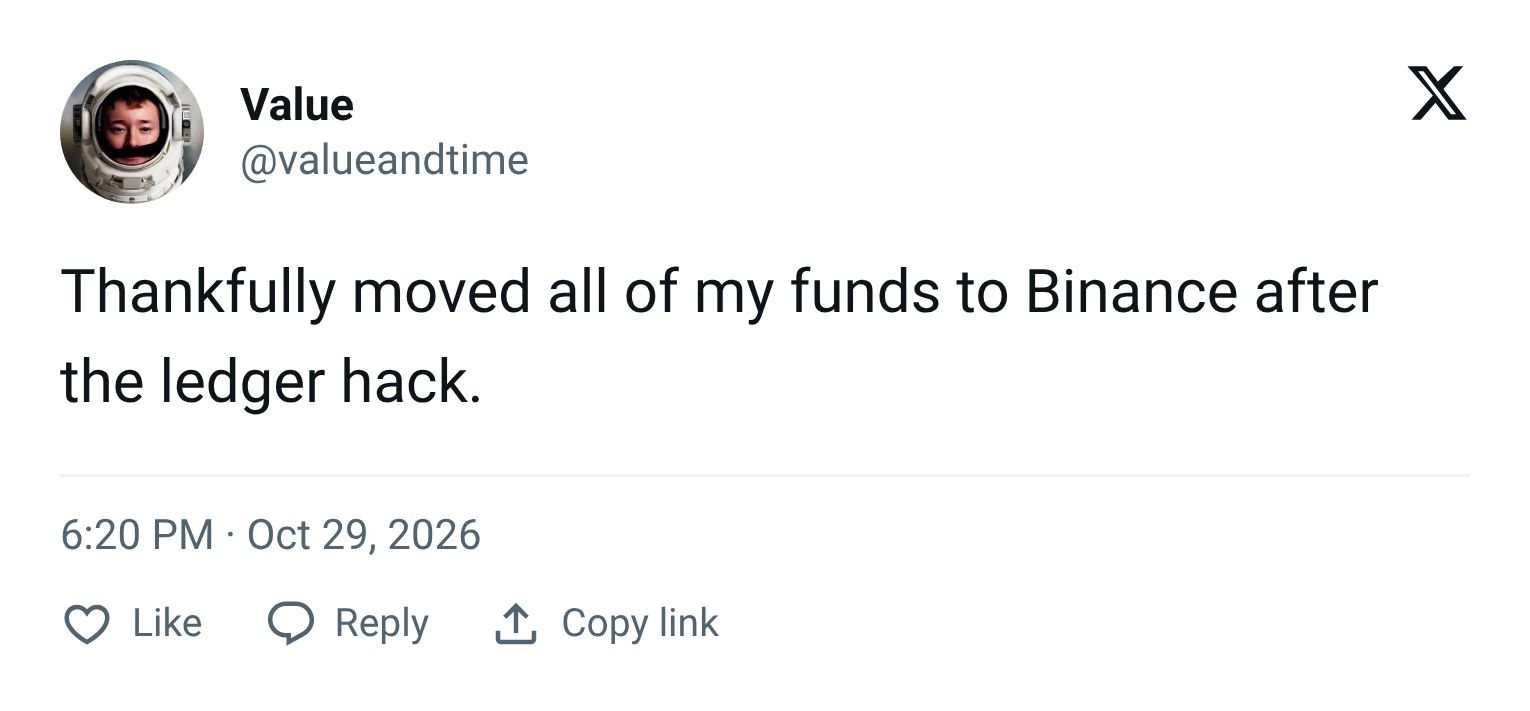
Crypto spent October warning people about tampered hardware wallets after implanted Ledgers were drained. Then on Thursday, Binance's hot wallets lost $6.3 billion in an afternoon. About two hours after the drain began, meme account Value summed up the month:
If you like Unchained, subscribe on YouTube · Apple Podcasts · Spotify, and forward this email to a friend.
