

Sadly, yet another news story shows just how dicey self-custody can be nowadays. What was billed as the most sovereign, trustless method has turned out to have a lot of little hidden trust minefields. However, whether or not this hack puts a dent in the “not your keys, not your coins” ethos remains to be seen.
How Far the Ledger Spy Implant Has Spread With $100 Million Stolen
The former Mt. Gox CEO turned hardware sleuth and SEAL 911’s Jonty on the implant behind the Ledger drains, and why they think we'll see more of it.
The Ledger wallet drains that started Oct. 9 grew into a full supply chain scare this week. On Thursday's Unchained livestream, Laura talked with two people who have been closest to it: Mark Karpelès, the former Mt. Gox CEO who now runs Karpelès Lab and has been taking tampered devices apart, and onchain investigator Jonty, founder of Pangolin Intelligence and a SEAL 911 contributor.
Karpelès said he found the implant in devices from two more authorized resellers: a Ledger Flex from Metapod at Singapore's Changi Airport, and a Nano X from MediaMarkt in Germany.
The implant uses three chips. One reads the screen, one is a cellular modem and one is an eSIM that sends the data out.
He said the newest version clips into place and is "made for mass production," and that "we're likely going to see a lot more of it."
Jonty said all the hands that touch these devices in Ledger’s supply chain will be scrutinized.
He added that while recovery would require law enforcement from various jurisdictions, he’s “cautiously optimistic” about it.
Watch on YouTube or X · Listen on Apple Podcasts · Spotify
Last call: Our listener survey closes tomorrow, Sunday, Oct. 18. It takes five minutes, it's anonymous, and it decides which shows we make next and when we stream them. You can enter the drawing for a free year of Premium at the end. Take it here. —Laura
In this week's edition:
🔓 Ledger's spy implant turns up beyond one reseller
🚔 Richard Heart is detained in Istanbul
📉 Bitcoin slips after a hot inflation print
📊 MSCI moves to drop Strategy and Metaplanet
💸 Tether money traced to Bo Hines' firm
⚖️ The CFTC writes prediction markets into its swap rules
🇪🇺 USDC becomes the EU's first "significant" stablecoin
🔐 Starknet and Coinbase prepare for quantum
🟣 Balaji's Network School buys Farcaster
😂 Fun Bits: the Richard Heart saga in one tweet
Ledger's Spy Implant Turns Up Beyond One Reseller
What began as a wave of drained wallets on Oct. 9 turned into the biggest hardware wallet scare in years. Ledger said devices sold by CryptoBilis, an authorized reseller in Southeast Asia, carried an unauthorized implant. During setup, the implant read the 24-word recovery phrase off the screen and sent it out over a cellular connection.
The losses are still being counted. Ledger hasn't given a total, but blockchain data firm Bitquery's latest tally is $102 million taken from 324 wallets. Tether has frozen about $10 million in USDT tied to the theft.
The scare spread fast. MediaMarkt Saturn pulled Ledger devices on Oct. 13, Ledger asked sellers in seven Asian markets to pause sales, and rival Trezor cut back its own reseller list. Then Karpelès said he'd found the implant at two more resellers, though Ledger says the German stock it inspected was clean. Meanwhile, Uneasy Money co-host Taylor Monahan said the newest loss reports she's handling come from scams targeting panicked owners, not implants. Her advice: "Don't panic."
And in a twist of timing, Ledger unveiled its $849 Atom, a cellular-connected device that runs everyday apps, on the same day it published its account of the attack.
Richard Heart Detained in Istanbul on Finland's Red Notice
HEX and PulseChain founder Richard Heart was taken into custody in a dawn raid on an Istanbul home on Wednesday, according to Turkish media. The reports tied the operation to an Interpol Red Notice issued at Finland's request. Finnish authorities remanded him in absentia in 2024 on suspicion of tax evasion and of assaulting a 16-year-old in 2021.
Turkish outlets gave very different accounts of what police seized, ranging from $600,000 and 24 watches to $4 million and 64 luxury watches. No official inventory has been published. As of Friday, no court-ordered arrest, release or formal extradition request had been reported, and Heart hadn't commented publicly.
His tokens took the hit: HEX fell about 32% and PulseX about 36% in a day. In the U.S., a judge dismissed the SEC's fraud case against Heart in 2025 for lack of jurisdiction.
Bitcoin Slips After a Hot Inflation Print
Bitcoin had a choppy week. A Monday slide set off about $771 million in liquidations. Then Wednesday's consumer price index showed U.S. prices rose 0.6% in September and 3.7% from a year earlier, with gasoline accounting for more than half the monthly increase.
By early Thursday, bitcoin had touched about $80,500. Asian markets were falling too: South Korea's Kospi fell more than 9% intraday, which triggered a 20-minute trading halt, and Japan's Nikkei closed down nearly 5%. Crypto liquidations topped $950 million over 24 hours, mostly from traders betting on prices rising.
Bitcoin was trading near $81,500 Friday afternoon. Traders now turn to the Federal Reserve's Oct. 27-28 meeting, the first since its September quarter-point hike, which was its first rate increase in more than three years.
MSCI Moves to Drop Strategy and Metaplanet
MSCI said on Oct. 15 that it will screen "non-operating companies" out of its global indexes, replacing the stopgap rules it had applied to crypto treasury firms since last year. Its list of potentially affected companies puts Strategy and Metaplanet in line for deletion at the November review. A final list is due Nov. 11, and the changes take effect after the close on Nov. 30.
Strategy's capital machine was already under strain. The company spent $192.4 million last week buying back its STRC preferred stock, nearly nine times the $21.5 million it put into bitcoin, and it paid for the bitcoin mostly by selling common shares. Shareholders vote Oct. 28 on paying daily dividends on STRC and three other preferreds. For the deeper dive, see this week's Bits + Bips Premium: Is Strategy's STRC Buyback Loop Running Out of Cash?
Tether Money Traced to Bo Hines' Firm
Nxum, a consulting firm Bo Hines co-owned while he led the White House's stablecoin push, has taken in about $6.3 million under a Tether marketing deal, the Wall Street Journal reported. The first installment, $2.49 million, left Bitfinex in May 2025 and was routed through another marketing firm, while Hines was still in government and two months before the GENIUS Act became law. Hines joined Tether that September to lead its new U.S. business.
The Journal also reported that Hines pressed lawmakers to stretch the law's compliance window to 36 months from 18, a change that mainly benefited Tether. A Nxum representative told the paper that Hines didn't know about the firm's Tether business while he was in the White House and received no Tether-derived funds during that time. Tether didn't respond to the Journal.
The CFTC Writes Prediction Markets Into Its Swap Rules
The CFTC proposed defining event contracts on sports, politics, culture and weather as swaps, which would put them under its exclusive jurisdiction. In a companion rule, it carved sportsbook bets and casino games out of that definition. It's the agency's answer to states arguing that sports contracts are just gambling. Appeals courts have split on that question, and New Jersey has asked the Supreme Court to step in.
Kalshi CEO Tarek Mansour framed the stakes at DC Fintech Week: "It's not a choice of state versus federal market. It's a choice of whether prediction markets exist in the U.S. or whether they go offshore." Separately, a federal judge refused to undo Gemini's 2025 consent order with the CFTC, even though the agency joined the request. He ruled that a shift in enforcement priorities isn't a change in the law.
USDC Becomes the EU's First 'Significant' Stablecoin
The European Banking Authority named USDC the first "significant" e-money token under MiCA, out of 45 notified across the EU. Starting Nov. 12, the EBA will supervise the reserves, liquidity and capital of Circle's EU issuer, while France's ACPR keeps oversight of governance. Under MiCA, significant tokens must hold at least 60% of reserves as bank deposits, compared with 30% for other e-money tokens, a rule Circle has lobbied to loosen.
Circle also opened its books a little. Of about $1.4 billion in first-half revenue, roughly $819 million, or 59 cents of each dollar, went to distribution partners and transaction costs, $473 million went back into the business, and Circle kept 7 cents of profit per dollar. The post read as a reply to rivals promising partners nearly all of the reserve income, like the Coinbase- and Visa-backed Open USD, though Circle didn't name any.
Starknet and Coinbase Prepare for Quantum
StarkWare opened a vote on whether Starknet should research leaving Ethereum to become an independent post-quantum layer 1. Starknet can make its own components quantum-resistant soon, but its bridge and data layer move on Ethereum's schedule, which a standalone chain would avoid. Early results were nearly unanimous in favor. A yes only starts research, and voting closes Oct. 22.
On the Bitcoin side, Coinbase, which holds roughly 5% of all BTC by its own count, told developers that quantum-resistant upgrades should start now, before any threat is proven. It said they need to work for large custodians, favoring designs that can swap in new signature schemes later, and argued that what to do with dormant coins should be debated separately.
Balaji's Network School Buys Farcaster
Farcaster changed hands for the second time this year. Balaji Srinivasan's Network School acquired the decentralized social app and protocol from Neynar, which bought it in January. Terms weren't disclosed. Users are being asked to accept a "social smart contract" with new posting rules, recorded with an onchain access NFT. Its bannable "digital felonies" range from scams to repeatedly starting fights. Users who decline keep read-only access in the main app and can take their keys, followers and posts to another client. The app is being renamed the "Network State Protocol," and some users say they've already been banned over months-old posts, which The Block couldn't verify.
Related Listen:
Fun Bits: The Richard Heart Saga, in One Tweet
Turkish media greeted the detention with headlines about a "crypto whale," and Crypto Twitter took it from there. Crypto researcher Eric Wall condensed years of legal drama into a single post titled "How Richard Got Caught Explained 1 Tweet":
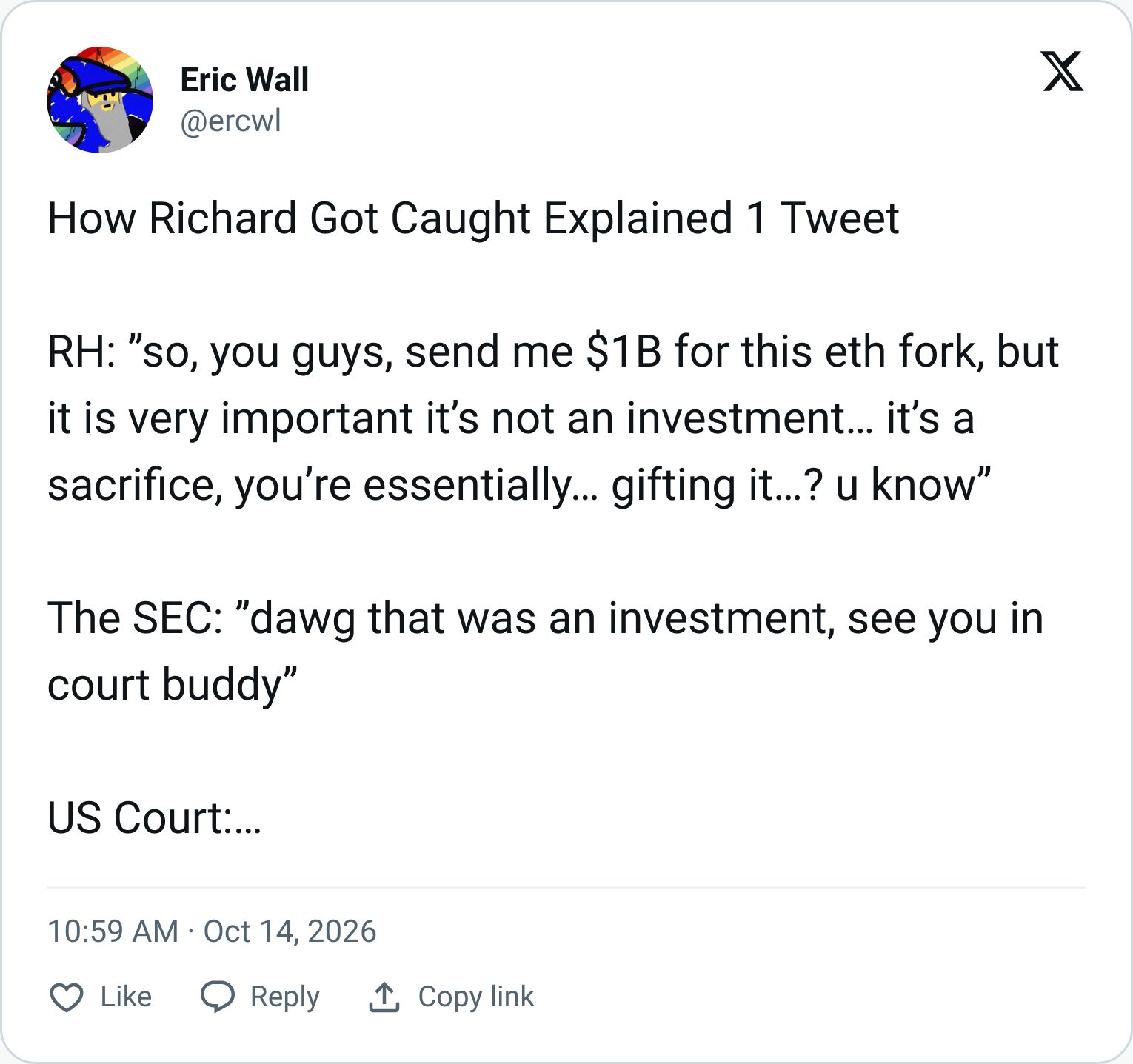
The fact-check is mostly a wash. Our one correction: by one Turkish count, 11 of those 64 watches were Pateks.

If you like Unchained, subscribe on YouTube, Apple Podcasts or Spotify, and forward this email to a friend who'd want it.
