- Unchained Daily
- Posts
- Bitcoin Touches $74,000 as Hormuz De-Escalation and Weak Dollar Fuel Best Week Since War Began
Bitcoin Touches $74,000 as Hormuz De-Escalation and Weak Dollar Fuel Best Week Since War Began
Plus: 🏛️ A crypto brokerage collapses amid commingling allegations, 🔷 Ethereum Foundation publishes its own sunset plan, 💥 Aave's worst week gets two very different explanations

Juan Aranovich
March 16, 2026
Hi! In today’s edition:
🟠 Bitcoin briefly touched $74,000 as Hormuz de-escalation signals and a weakening dollar fueled crypto's best week since the Iran war began
🏛️ BlockFills, a Chicago crypto brokerage, filed for Chapter 11 after allegations it commingled client funds and concealed trading losses
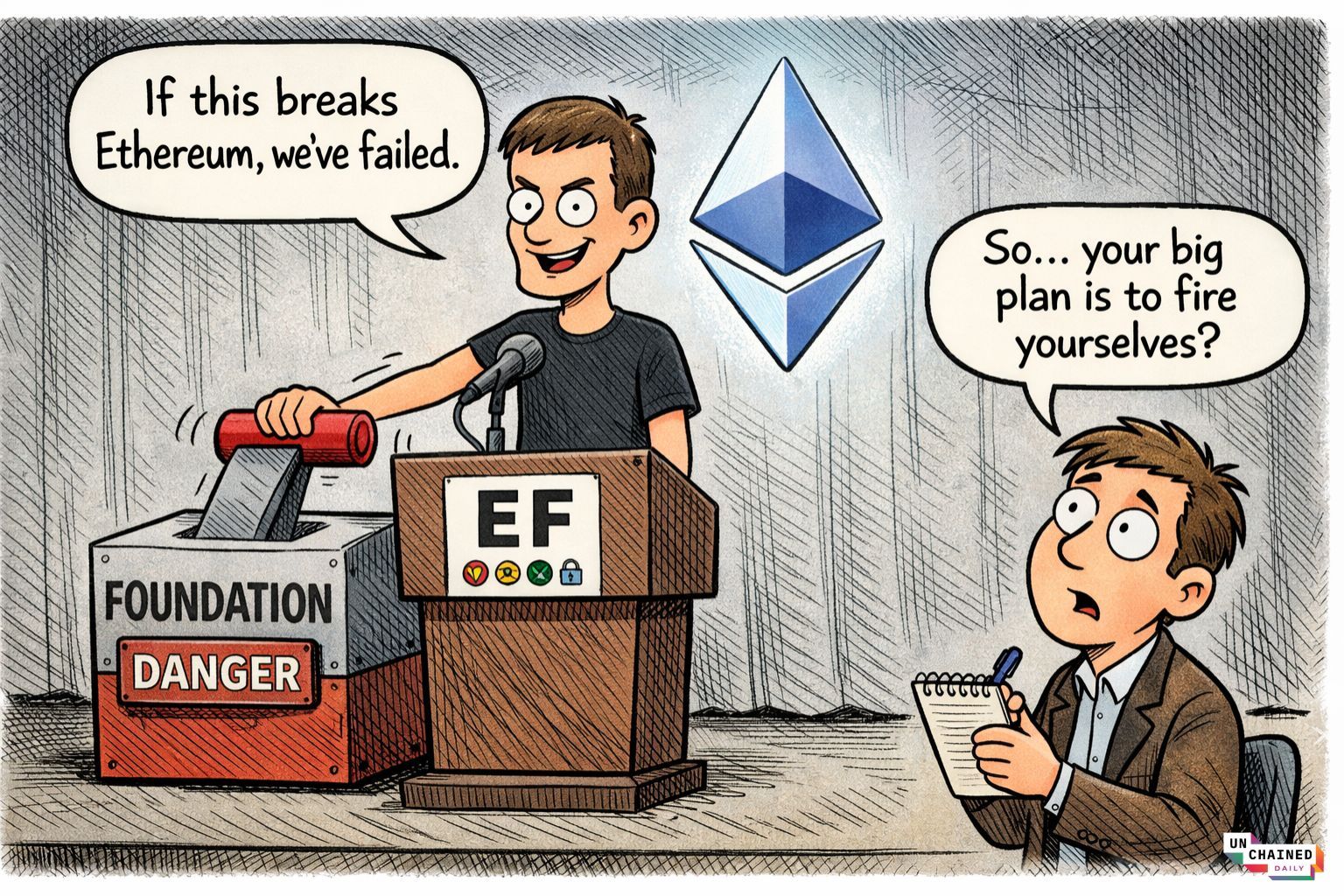
🔷 The Ethereum Foundation published a 38-page mandate codifying the principles it says must outlast the organization itself
💥 Aave and CoW Swap released competing post-mortems of a $50 million swap that left a user with $36,000 in tokens
Today’s newsletter is brought to you by Adaptive Security!

In crypto, the biggest losses don’t start with malware — they start with trust: a “founder” on a deepfake call asking for an urgent transfer, a cloned vendor voice “confirming” new banking details, or a perfectly-written email/DM that looks internal and reroutes funds.
Adaptive Security helps teams catch these AI-powered attacks before money moves:
Deepfake + social engineering simulations across channels
AI Content Creator that turns new threats, policies, or compliance needs into interactive, multilingual training in minutes
Trusted by Fortune 500s, Adaptive is backed by NVIDIA and OpenAI.

Bitcoin Touches $74,000 as Hormuz De-Escalation and Weak Dollar Fuel Best Week Since War Began
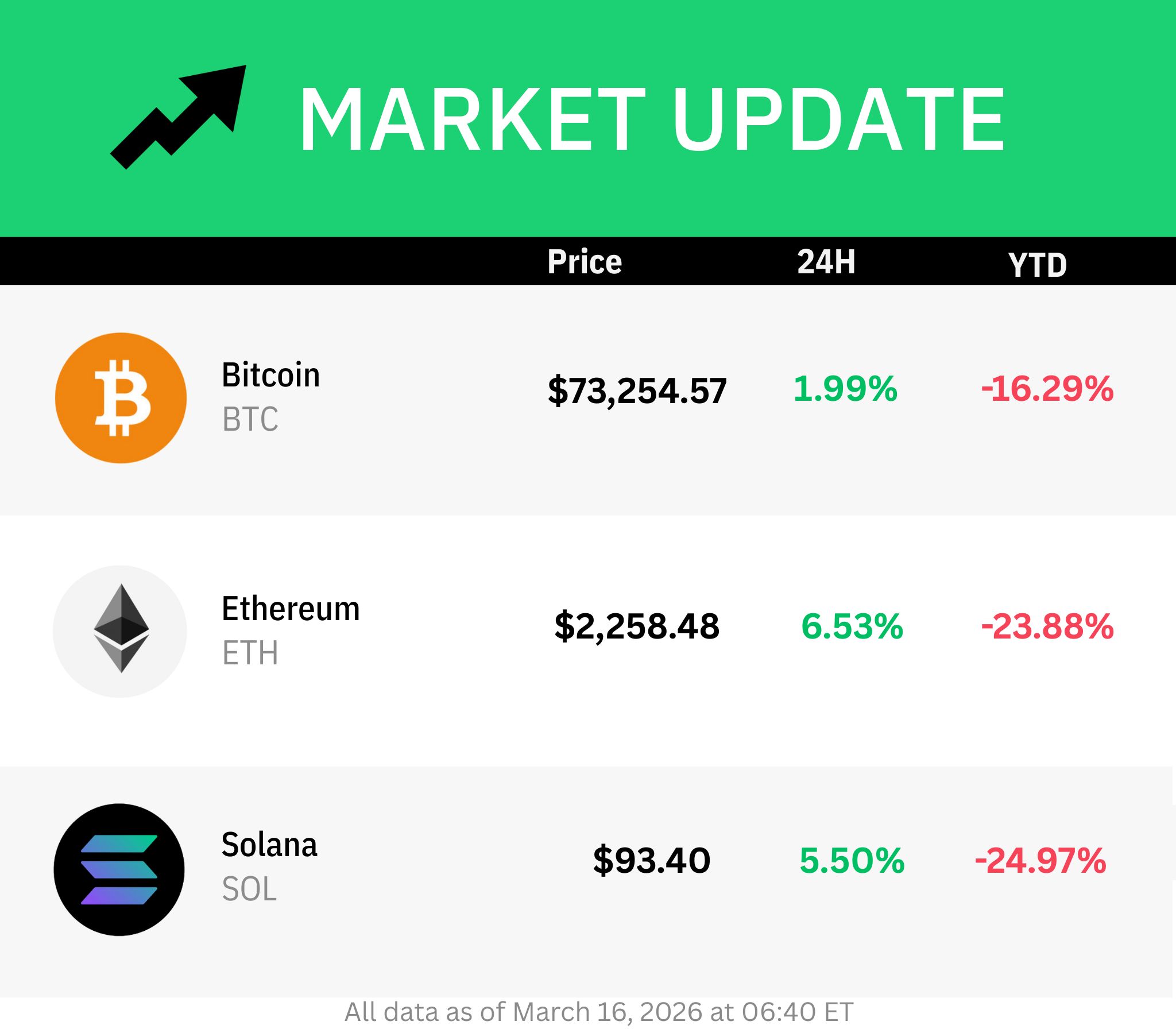
Bitcoin briefly punched through $74,000 on Monday morning before pulling back, leading a broad rally that gave crypto its strongest weekly performance since the Iran war started in late February. As of 6:30 a.m. ET, BTC traded around $73,400 with ETH at $2,268, up roughly 9% and 14% on the week respectively.
The trigger was a cluster of de-escalation signals arriving at once. Two tankers transited the Strait of Hormuz on Sunday, the first commercial passage since the war began, after Iran's foreign minister narrowed the shipping blockade to "enemy" vessels only. President Trump said the U.S. was in talks with Tehran. Oil pulled back from its highs, the dollar weakened, and S&P futures posted their first gain in five days.
Short sellers paid the price: $344 million in liquidations hit over 24 hours, with bears accounting for 83% of the total. Singapore-based QCP noted that the options market is now eyeing the $75,000 strike, where roughly 8,000 contracts of March 27 calls sit. A push above that level could force dealers to hedge aggressively, potentially accelerating the move.
The Fed's two-day meeting starting Tuesday looms as the next test. With oil still elevated but Hormuz reopening, the inflation picture looks different than it did a week ago.
We’ll Discuss All This Today on Bits + Bips
Inflation expectations posted their biggest monthly jump since the post-pandemic crisis, rate cut bets are evaporating, and three central banks meet this week with no good options.
On this week's Bits + Bips, Austin, Ram, and Chris also dig into Bessent's trade talks with Beijing, BlackRock's staked ETH ETF launch (and whether 3.1% yield competes in a 4.4% Treasury world), and the Ethereum Foundation's 38-page attempt to define its own future.
BlockFills Files for Chapter 11 After Allegations of Commingled Client Assets
The October crash has claimed another institutional player. BlockFills, a Chicago-based crypto brokerage that handled over $60 billion in trading volume last year, filed for Chapter 11 protection on Sunday in Delaware, listing up to $500 million in liabilities against no more than $100 million in assets.
The collapse followed a familiar sequence. BlockFills halted customer withdrawals in February, citing market conditions. Days later, creditor Dominion Capital sued the firm, alleging it had mixed client crypto with its own funds and concealed trading losses. A federal judge in New York subsequently froze bitcoin tied to the dispute. CEO Nicholas Hammer stepped down, replaced by interim chief Joseph Perry.
The filing names 007 Capital ($17.1 million), the Richard E. Ward Revocable Trust ($9.4 million), and Artha Investment Partners ($6.9 million) among the largest unsecured creditors. Backers include Susquehanna Private Equity and CME Ventures.
BlockFills is the first notable crypto firm to seek court protection since the bear market began, and the commingling allegations will invite uncomfortable comparisons to earlier industry failures.
Ethereum Foundation Codifies Its Own Obsolescence in New Mandate
The Ethereum Foundation wants you to know it plans to disappear, and it just published a 38-page document explaining why that's the point. The "EF Mandate," released Friday, codifies what co-founder Vitalik Buterin calls the "walkaway test": the idea that Ethereum should function perfectly even if the Foundation and its current developers vanished tomorrow.
At the document's core are four non-negotiable properties the Foundation says must guide all protocol decisions: censorship resistance, open source, privacy, and security, collectively branded "CROPS." The mandate treats these not as aspirations but as preconditions, declaring they form "an indivisible whole" that no development priority can override.
The timing matters. The mandate arrives weeks after co-executive director Tomasz Stańczak stepped down to return to active building, leaving Hsiao-Wei Wang and interim co-director Bastian Aue to steer the organization. Community frustration over the Foundation's pace and transparency had been building for months before the leadership reshuffle.
In practical terms, CROPS will serve as a filter for funding, research, and protocol upgrades, meaning proposals that trade privacy or decentralization for convenience now face a higher bar.
Dueling Post-Mortems Reveal How a $50 Million DeFi Swap Went From Bad to Catastrophic
Aave's worst week in recent memory now has competing explanations. On Saturday, both Aave and CoW Swap released their own autopsies of the March 12 incident in which a user converted $50.4 million in aEthUSDT into roughly $36,000 worth of AAVE tokens, what many are calling the largest single-trade execution loss DeFi has ever seen.
The narratives split on responsibility. Aave pinned the outcome on thin liquidity, pointing out that the user confirmed a 99.9% price impact warning on a mobile device before proceeding. CoW Swap's account was far grimmer: legacy code enforcing a stale gas ceiling filtered out better-priced quotes, a top-performing solver won back-to-back auctions yet never broadcast either transaction to the chain, and blockchain evidence points to the trade leaking from a private mempool, likely enabling the roughly $34 million in value that block builder Titan Builder captured.
The blowup compounds an already bruising stretch for the $26 billion protocol. An oracle misconfiguration two days prior had forced $26 million in wrongful wstETH liquidations, and a months-long governance fight over swap fee transparency recently pushed out the Aave Chan Initiative, the DAO's most prolific contributor.
Aave's fix is "Aave Shield," a default block on any swap exceeding 25% price impact. CoW Swap went further in self-examination, conceding that a confirmation checkbox amounts to little when $50 million is on the line.

🇦🇷 🔍 Argentine forensic analysts found at least five messages between Milei's inner circle and Libra memecoin promoters, timed to the exact moment the president posted the token's contract code to X, undercutting his claim that he stumbled on the address publicly.
🗳️ 🏛️ World Liberty Financial, the DeFi protocol backed by the Trump family, passed a governance vote creating a tiered staking system where five million dollars in locked tokens buys direct access to the team for partnership discussions, with 76% of the voting power coming from just 10 wallets.
💵 📊 Circle overtook Tether in year-to-date stablecoin transaction volumes for the first time in six years, processing roughly 2.2 trillion dollars against Tether's 1.3 trillion dollars, a reversal that prompted Mizuho to raise its price target on Circle shares to $120.
🐋 🎰 A crypto wallet dormant for five months sprang to life hours before a Mar-a-Lago gala was announced for top TRUMP token holders, scooping up roughly seven million dollars worth of tokens and booking an estimated 2.5 million dollars in profit as the price surged over 60%.
🗳️ 💰 FairShake and allied crypto super PACs have poured 271 million dollars into the 2026 midterms so far, with Coinbase, Ripple, Uniswap Labs, and Andreessen Horowitz among the top backers and just under 40% of the money flowing to Republican candidates.
⚖️ 🔓 Federal securities regulators permanently dropped their fraud case against BitClout and DeSo creator Nader Al-Naji, dismissing with prejudice the allegations that he funneled over seven million dollars in investor funds toward personal expenses including rent on a Beverly Hills mansion.
🏦 📉 Sky's governance body voted to cut daily token buyback spending by 87% for three months after S&P Global flagged reserve levels as a material weakness, redirecting funds from market support to stablecoin backing for USDS and DAI.
🔴 🛡️ An attacker inflated the price of Thena's thinly traded THE token from $0.27 to nearly $5 on Venus Protocol through a classic oracle manipulation loop, borrowing against the pumped collateral and sticking the BNB Chain lending platform with roughly 2.15 million dollars in bad debt.

🔷 🤝 BitMine, the publicly traded ether treasury firm chaired by Fundstrat's Tom Lee, acquired 5,000 ether from the Ethereum Foundation in a 10.2 million dollar over-the-counter deal, with proceeds directed toward protocol research and ecosystem grants.


Bloomberg: Polymarket Five-Minute Bets Capture ‘Addictive’ Crypto Craze
CELO (GREEN) OPERA by Austin Campbell