- Unchained Daily
- Posts
- Vitalik Pushes to Rein In Builder Power Ahead of Ethereum’s Glamsterdam Upgrade
Vitalik Pushes to Rein In Builder Power Ahead of Ethereum’s Glamsterdam Upgrade
Plus: 🏛️ Senate advances housing bill with CBDC ban, 📈 Nasdaq eyes prediction markets, ⛏️ Riot posts record revenue despite mining losses.

Juan Aranovich
March 03, 2026

Hi! In today’s edition:
🧱 Vitalik targets block builder dominance ahead of Glamsterdam
🏛️ Senate advances housing bill with CBDC ban through 2030
📈 Nasdaq files with SEC to launch binary prediction contracts
⛏️ Riot posts $647.4 million in revenue but reports $663 million loss
Today’s newsletter is brought to you by Fuse Energy!

Fuse Energy hits a $5B valuation on the cusp of launching their $ENERGY token
Fuse Energy is a $400M ARR utility powering 250,000+ homes, and has recently announced a $70M series B at a blockbuster $5B valuation.
The Energy Network is set to launch soon. It is a new digital layer engineered to scale our grids and save billions in costs.
And now, it’s just building momentum:
$170M raised to date
$5B valuation
Beta live on Solana
Landmark SEC no-action letter secured
Planning listings soon
A new foundation for the grid is coming.

Vitalik Targets Block Building as Ethereum Prepares Glamsterdam Upgrade
Vitalik Buterin is zeroing in on a part of Ethereum that most users rarely think about but that plays a critical role in decentralization: who decides which transactions make it into a block.
In a post on X, Vitalik outlined concerns that Ethereum’s upcoming Glamsterdam upgrade, which introduces enshrined Proposer Builder Separation, could unintentionally concentrate power among a small group of sophisticated block builders. While the upgrade is designed to prevent staking centralization, Vitalik argues it does not automatically solve the risk of builder dominance.
One proposed safeguard is FOCIL, short for Forward Obligatory Commitment to Inclusion Lists. Under this design, a randomly selected group of participants would ensure certain transactions must be included in a block or the block would be rejected. The goal is to preserve censorship resistance even if a single builder gains outsized influence.
Vitalik also addressed so-called toxic MEV, suggesting encrypted mempools to prevent frontrunning and sandwich attacks. As Ethereum scales, he argues, decentralization challenges are shifting from validators to the infrastructure that determines what actually lands onchain.
Senate Advances Housing Bill With Temporary CBDC Ban
The U.S. Senate has advanced a sweeping bipartisan housing package that also includes a temporary ban on a central bank digital currency. Lawmakers voted 84 to 6 to move forward with the 21st Century ROAD to Housing Act, clearing a key procedural hurdle and setting up full debate.
Tucked into the 303 page bill is a provision that would bar the Federal Reserve from issuing or creating a CBDC through Dec. 31, 2030. The language states the Fed may not launch a digital dollar directly or indirectly through financial institutions. It carves out an exception for private, open, dollar denominated digital currencies that preserve the privacy protections of physical cash.
The White House quickly backed the bill, saying the president would sign it in its current form and highlighting concerns that a CBDC could threaten personal privacy and liberty.
Fed officials have previously said any digital dollar would require explicit congressional approval. For now, the debate over a U.S. CBDC has been pulled squarely into mainstream legislation.
Nasdaq Eyes Prediction Markets With SEC Filing
Nasdaq wants in on the fast growing prediction market business and is going through the SEC to do it.
The exchange operator has filed for approval to list what it calls Outcome Related Options, binary contracts priced between 1 cent and $1 that allow traders to bet on yes or no outcomes. The initial focus would be on the Nasdaq 100 index and its micro version, giving investors a way to take all or nothing positions tied to major market benchmarks.
If approved, this would mark Nasdaq’s first formal step into prediction markets. Unlike platforms such as Kalshi, Polymarket and Crypto.com, which operate under CFTC oversight, Nasdaq’s contracts would fall under the SEC framework. That distinction highlights the ongoing debate over which regulator controls event based derivatives.
Wall Street is clearly paying attention. ICE has invested up to $2 billion in Polymarket, CME has partnered with FanDuel, and Cboe is pursuing similar binary offerings.
Prediction markets have surged since the 2024 election cycle. Now traditional exchanges want a share of that momentum.
Riot Delivers Record Revenue as Mining Industry Feels the Squeeze
Riot Platforms posted a record $647.4 million in revenue for 2025, up 72% from the prior year, even as many rival miners struggled with weaker crypto prices. The bulk of that came from $576.3 million in bitcoin mining revenue, driven by higher average BTC prices and a rise in operational hash rate. Riot produced 5,686 BTC in 2025, up from 4,828 the year before.
Still, it was not all smooth. The average cost to mine one bitcoin climbed to $49,645, reflecting a sharp increase in global network hash rate that made mining more competitive. Despite the revenue milestone, Riot reported a $663 million net loss, largely tied to accounting adjustments and changes in the paper value of its bitcoin holdings.
Riot ended the year with 18,005 BTC, worth about $1.6 billion at year end prices, plus nearly $310 million in cash. As other miners report falling revenue and deeper losses, Riot is also pivoting toward AI and data center infrastructure, signing a deal with AMD as it looks to diversify beyond pure bitcoin mining.
Today: Unchained on Air
Prediction markets are under scrutiny, stablecoin rules are advancing, AI layoffs are accelerating — and Bitcoin is navigating geopolitical and macro stress in real time.
Join us starting at 12pm ET for a continuous livestream: DEX in the City examines insider trading allegations, the OCC’s stablecoin proposal, and AI’s economic impact.
Then at 1pm ET, on Unchained we break down Bitcoin’s reaction to war, gold comparisons, Jane Street rumors, and onchain versus macro data.
Bits + Bips is spreading its wings
Starting soon, new episodes will only be published on our brand‑new feeds.
What you need to do:
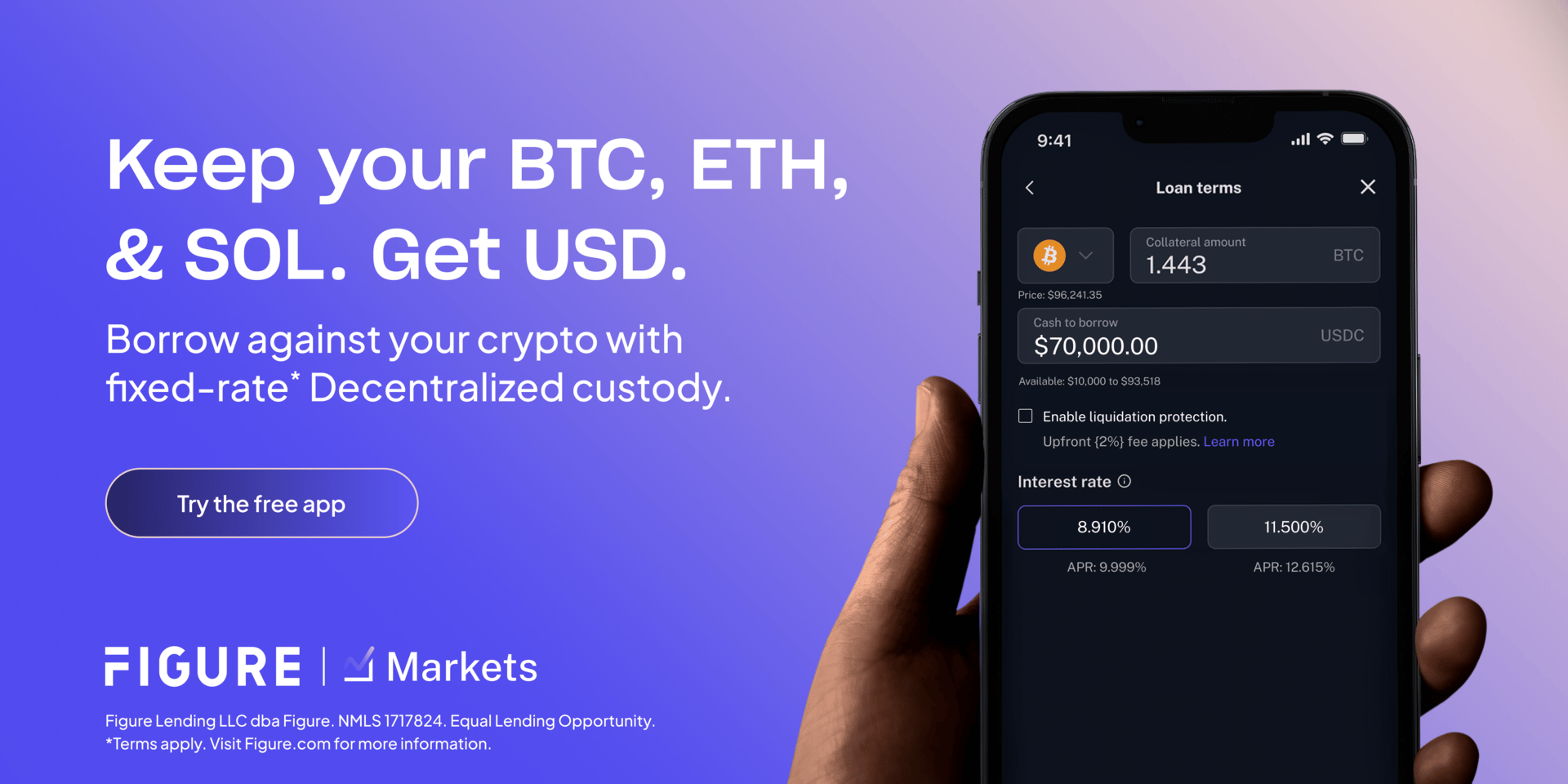
We all know the mantra: Not your keys, not your coins. But managing self-custody while trying to access leverage is a headache.
Figure bridges this gap for their Crypto Backed Loans with decentralized MPC custody. Your assets sit in a segregated wallet where you retain ownership—no opaque "commingled funds" risks here.
They are also tackling the biggest anxiety in lending: flash crashes. Their Liquidation Protection for BTC and ETH specifically protects you from getting wiped out during large price drops.
You get the best of both worlds:
Safety: Institutional-grade MPC custody.
Access: Borrow at just 8.91% on Crypto Backed Loans.
Yield: Earn up to 9% APY on cash, backed by real-world assets (HELOCs) with Democratized Prime.
Sleep better knowing your assets (and your upside) are protected.

🐸📱 Pump.fun, the dominant Solana-based memecoin launchpad, expanded its mobile app to support rival token generators and major bridged assets like Wrapped Bitcoin and Ethereum, aiming to keep traders inside one ecosystem as competition intensifies for user attention and onchain trading volume.
🤖🔗 OKX introduced an AI-powered upgrade to its OnchainOS developer platform, creating infrastructure that lets autonomous trading bots execute complex strategies across more than 60 blockchains and 500 decentralized exchanges using high-level instructions instead of manual coding.
⚖️🦄 A New York court dismissed a class action lawsuit against Uniswap Labs, the developer behind the Ethereum-based decentralized exchange, ruling that creators of open-source smart contracts cannot be held responsible for fraudulent activity carried out by third parties on the protocol.
🇰🇷📸 South Korea’s National Tax Service lost $4.8 million in seized cryptocurrency after accidentally publishing a photo that clearly showed hardware wallet seed phrases — the secret recovery words that control access to funds — marking the country’s second major government crypto loss and triggering a police probe and external security overhaul.
🏦💵 Anchorage Digital Bank released the first reserve attestation for USAT, Tether’s U.S.-regulated stablecoin, showing $17.6 million in cash and Treasury-backed assets supporting 17.5 million tokens, marking an early transparency milestone for the federally supervised dollar-pegged token launched under new U.S. stablecoin laws.

🇮🇷💸 Crypto outflows from Iran’s largest exchange, Nobitex, surged 700% within minutes of U.S.-Israeli airstrikes on Tehran, according to blockchain analytics firm Elliptic, suggesting rapid capital flight as users moved funds offshore through digital assets to bypass traditional banking channels.
🏦💶 Qivalis, a consortium of 12 major European banks including BBVA and BNP Paribas, is negotiating with crypto exchanges and liquidity providers ahead of launching a euro-backed stablecoin, positioning it as a regulated alternative to dollar-based tokens and backing it 1:1 with bank deposits and short-term sovereign bonds.


